Art &
Artist’s Buzz
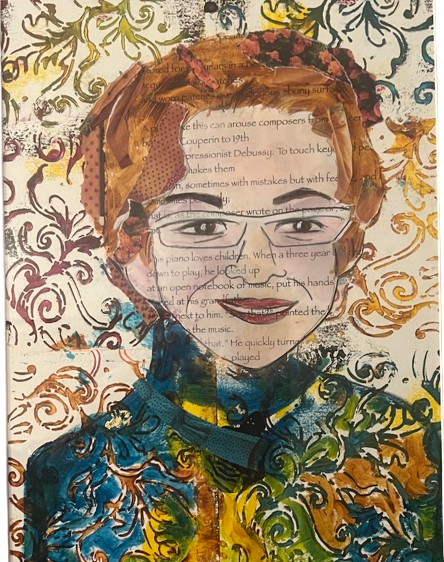
MIXED MEDIA ARTIST: SUE ARKANS
Resides and paints in Alford, Massachusetts. Portrait of Mary K Lindberg made of cold wax, oil paint, paper, pastel. Gossip has it one fleck of gold paint from Gustavo Klimt’s palette was used as well. Lines of poetry across the face are from the poem “Three-Legged Body” in Dance of Atoms.
.
Book Cover Artist
Julian Potulicki
I am indebted to the artist who created the painting on the cover of Dance of Atoms—Julian Potulicki. He is clearly prescient in imagining what, in his words, “Galactic Flowers” look like. His depiction occasioned the poem named for the painting. It dramatically unites the three parts of Dance of Atoms—an unexpected volcanic eruption, significant works of art, literature, and the variety of aesthetic attributes one finds in the performing arts, literature, and nature.
-Mary K. Lindberg
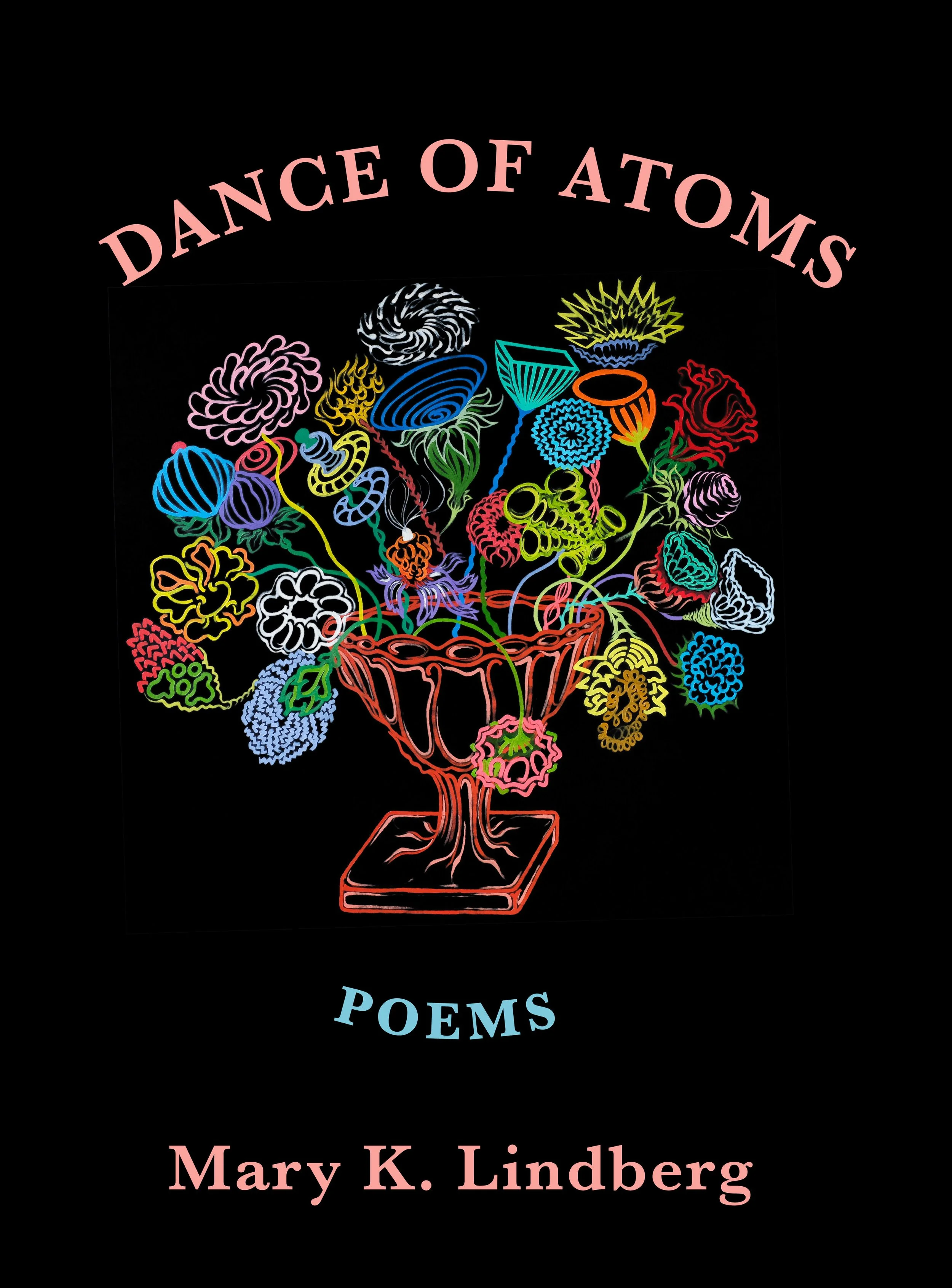
Dance of Atoms
Dance of Atoms
The Ekphrastic Review: Mary, talk to us about Dance of Atoms.
Nov 20, 2025
Mary Lindberg: In this poetry collection, I take liberties. I bring back to life the victims of the 79 CE eruption of Mount Vesuvius to show us their last moments in Pompeii, Herculaneum, nearby villas. Figures in art come to life to socialize; some to challenge, confront spectators. Newly-roused composers Mozart and Beethoven critique today’s performances of their music.
Let’s not forget Franz Liszt, the probable very first “rock star” of the musical world. His mesmerizing virtuosity drove women to snip his clothes for souvenirs. Other poems explore nature’s healing power, examine the role of truth in memoir, inquire if an MRI can be a poem.
Such liberties confirm my sense that the world is in constant motion, atoms are always dancing, if people can free themselves and use imagination. The specific phrase “dance of atoms” comes from Mrs. Natica Aguilly, a California artist, dancer, and poet who has spent decades internationally promoting poetry and dance as a unified art, exemplified in the annual Dancing Poetry Festivals she created. I take from her the idea that atoms of life can dance and create, by participating in imaginative forms of art.
This collection is divided into “Vesuvius at Your Back,” “Locked in Oil,” and “Life’s Tumultuous Surprises.”
The Ekphrastic Review: The first part of your book is a series of poems inspired by the eruption of Mt. Vesuvius in 79 CE. Tell us about your fascination with this part of history. How did this interest turn into poetry?
Mary Lindberg: I have always been fascinated by the tragedies of Pompeii and Herculaneum that occurred when Mount Vesuvius erupted unexpectedly. This interest grew when I saw the Pompeii casts of victims and Herculaneum skeletal remains on trips to Italy, and read the letters of contemporary Pliny the Younger describing escape with his mother at Misenum, and his uncle Pliny the Elder’s death on the Bay of Naples shore.
To glimpse unguarded moments just before death made me curious about life. When shaking began, what were people doing? Working? Relaxing? Eating? Stealing? Making love? Writing? Those silenced first-century Romans and their slaves invited me to create fictional identities to show them alive, along with their aspirations and relationships, the very moments the eruption began.
Remnants of life 2,000 years ago continue to fascinate. In May 2025 The New York Times reported on a newly discovered Pompeiian house where a bed was used to barricade against the first geologic onslaught. That inspired my poem “How To End a Poem.”
Further, scholars have found that there were survivors, those who managed to leave before debris and pumice locked people into pillars and pyroclastic flows boiled human brains. Using Pompeiian family names, researchers have found that some survivors left early enough, and were able to thrive. Because Pompeii has only been one-third excavated, much more will be revealed in the coming years, especially with new technologies in archaeology.
The news suggested a way to begin the book. A 22-year-old American man from Maryland climbed a forbidden path to the summit of Vesuvius in July 2022, tried to take a selfie, dropped his phone, and tumbled down toward the crater’s bottom. He was rescued by Italian guards who had followed him on the restricted path. His back was bloody from scraping the crater, but he is alive. His photographic disaster turned into the first poem, “Shooting Vesuvius.”
The Ekphrastic Review: Your book has sections on poems inspired by visual art, as well as being inspired by performing arts and music. What common thread do you see that connects these diverse arts?
Mary Lindberg: First, the personal. I have a deep interest in music, having studied piano for many years, even performing as a teenager on TV, and I attended the Eastman School of Music. But, as the saying goes, "I cannot draw a straight line." Later, when selecting an English doctoral thesis, subject, I studied British artist and social satirist William Hogarth (1697-1764), and found striking interconnections between his art and the London theater in form and content. At the time, an evening at the theater, at a minimum, consisted of a musical number, a prologue, the play with entr’actes of dance and music, and an epilogue. My focus was on the visual, his art, and what it meant at that time.
To your question, the common thread is a striving toward expression of the inexpressible, such as love, life, grief, death — what can be called universals. In music it is more difficult to describe, but I believe the urge is the same. Music is usually part of dance, but choreography offers another dimension, attempting to demonstrate in gesture the inexpressible. All are part of atoms dancing.
The Ekphrastic Review: Tell us about your relationship with visual art. Were there any specific experiences that invited you in? What does art mean to you?
Mary Lindberg: Just as I see the victims of Vesuvius alive seconds before death, surrounded by beautiful, fanciful frescoes, I see works of art as living objects, despite being made of marble, alabaster, or centuries-old paint and fresco. Thus a painted basket of ripe figs on the damaged wall of the Villa Oplontis became a symbol of the flirtation between Flavia and a Roman soldier, so I placed a basket of figs on the table between them in my poem “Garden Room, Villa Oplontis.”
In short, to me, art isn’t fixed in time or intention, it’s a jumping off point for the imagination.
I also picture works of art communicating after hours in museums, as when a Matisse odalisque slides down the stairs in New York’s Metropolitan Museum of Art to visit a marble hunter in my poem “After Dark After Restoration.” In another vein, it is human to be full of mystery and ambiguity. I find that the enigmatic nature of many portraits suggests this is true. That makes me think about what sitters may be thinking. Could I be gazing at represented fantasies, unimaginable dalliances, power clashes? I’m inclined to think so.
In “Hushed Hint of a Sneer,” I speculate from the sitter’s facial expression and dress what emotions might be behind or in it, and to whom they might be directed. Thus my psychological response becomes the basis of the ekphrasis.
In reviewing a recent Kerry James Marshall exhibition in London, Emily LaBarge says that, when looking at Marshall’s paintings, “it often seems the figures we behold … stare out watching us watching them and together we are all part of the project of art, which is a project of looking.” (New York Times, 10/2/25, C5). I agree.
The reviewer adds, in some Marshall paintings the spectator becomes the subject, and “the great question becomes not what are you looking at, but who you, the viewer, are. And what you want to see.” That is the essential idea of my poem, “What We Exhibit.” The “we” is the viewers, you and me walking in a gallery, peering at subjects, paint, even frames; while, at the same time, we “exhibit” revealing personal data about ourselves.
The Ekphrastic Review: Tell us about your ekphrastic process. How do you choose the artworks you write about? Were there any surprises in your writing or selection process, or in the paintings themselves? What does art mean to you?
Mary Lindberg: Such good questions. I always look for surprises in works of art, or one could say, contrasts. In a large 16th century painting of Diana and Actaeon, by Titian, I see a curious, timid, pretty girl observing the actions of the gods, as if she is an in-painting spectator. In Francesco Goya’s Portait of Ferrer, I examine the thoughtful expression on the sitter’s face. On closer examination of his pose and the way he holds his book, the portrait opens up questions about his emotional life that I perceive him asking himself.
The Ekphrastic Review: You mention in the collection’s notes that writing these poems was an act of resilience in the aftermath of cancer and the side effects of treatment. Tell us about this. How did ekphrasis and other writing help?
Ekphrastic writing helps me understand what I’m looking at.
For example, I saw a New York Times photograph and article about the Italian restorer who cleans Michelangelo’s seventeen-foot statue of David periodically. The woman stands on tall scaffolding, leaning over to brush the thigh of the giant statue, a tiny figure next to David. She must have unique moments of perception, I thought, being that physically close to David, one of the most perfect works of art. She can more easily see what we cannot. For instance, the pupils of his eyes are sculpted in the shape of hearts, which I discovered on a post card. The poem “Preserving Perfection” is the result of all this.
To your question about cancer. After receiving my final biopsy report, I had completed the first section of Dance of Atoms. I thought of this as a standalone short book. Successive bouts of chemotherapy, radiation until finally, eliminating the lymphoma by CAR T-Cell immunological treatment, ended less than a year later. During that time all I wanted to do was extend and finish a longer book about literature, music, nature and art.
It was at first difficult to write about the medical procedures I experienced. The awareness that I would have to work very hard simply to walk again, and that my numb right foot is the piano’s pedal foot, threatened depressive thoughts. But as rehabilitation progressed, it was easier to write about how nature’s autumn colour change stirs new emotions, even joy at the possibility of walking again. Driving toward that goal made completing Dance of Atoms significant.
The Ekphrastic Review: What’s next for Mary?
Mary Lindberg: I have finally begun to write about many of the experiences I had during cancer: questions, fears, hopes, the wait for a biopsy result, and other hospital out-of-body experiences. Considering that I am completely free of lymphoma, it is easier to write. Atoms dancing enables me to imagine totally new approaches to medical procedures and healing, and to the myriad possibilities poetry itself offers.
June Gould, Ph.D.
Short Guide to Good Poems
1. Poetry is more than just arranging words. Poetry is an art that details human experience through emotion, and thought into a selection of form
2. Writing poetry allows you to explore deep feelings and observations
3. Poetry turns language into a powerful force for expressing the inexpressible
4. At its heart, poetry is about observation and reflection
5. Imagery and metaphor are essential to good poetry
6. Learning how to write poetry is being vulnerable with yourself or with an audience
7. For beginners or seasoned poets, the key to writing poetry is to stay true to your voice. You can play with English, French or Japanese forms, but in the long run, your words must find their own form, their own self-discovery, their own creative expression
8. Writing poetry promotes questioning
9. Writing may be permanent in a book, letter or computer 10. Writing poetry refines your ideas.
MARGARET LUCKE:
Eight Tips for Writing Great Fiction
Margaret Lucke is an author, editor, and teacher of writing classes in the San Francisco Bay Area. She writes tales of love, ghosts, and murder, sometimes all three in one book. She is the author of four mystery and suspense novels, numerous short stories, and books on the craft of fiction. Visit her and join her mailing list at https://margaretlucke.com/
Here are a few of the things that teaching has taught me about writing great fiction.
1. Great characters are the basis of great fiction. Who the story is about is more important than what the story is about. Readers crave characters they can believe in, relate to, and root for, and they’ll remember great characters long after plot details fade. This is true even of villains, the ones that readers love to hate.
2. A great story describes a journey that changes someone. A story sends your protagonist from Point A—what her life is like as the story opens—to Point B, the place where she arrives as a result of what occurs along the way. Whether the journey is geographical, emotional, or psychological in nature, nothing afterward will be quite the same as before. This journey defines what is sometimes called the character arc.
3. A great plot makes characters struggle with conflicts as they try to achieve their goals. What sets your character on the journey? Something happens that presents a problem, a challenge, or an opportunity. If she solves the problem, meets the challenge, or takes advantage of the opportunity, she can achieve an important goal or attain a cherished desire. But roadblocks, complications, and persons with opposing goals stand in the way. At its most basic, a story is this: A character tries to overcome obstacles to achieve a goal. Conflict lies at the heart of any great story.
4. Great fiction provides readers with an emotional experience in a vivid story world. More than just setting, the story world is the physical, cultural, and emotional environment in which the narrative takes place. A well-told story brings the readers inside a fully realized story world and makes their experience there rich and satisfying. When readers’ emotions are engaged and they feel like they’re right there in the middle of things—that’s when they can’t put the story down.
5. Every great story is a suspense story. No story can succeed without suspense—the artful tension the author sets up between the readers’ hopes and fears, between their concern for the characters and their uncertainty about what lies ahead. Make your readers care, raise questions they want answers to, and make them wait to learn the answers. That way you’ll keep them turning the pages to discover how it will all turn out.
6. Great fiction is told from a clear and distinct POV. Point of view, or POV, is the vantage point from which your readers observe and participate in the story events—whose eyes they look through, whose heart and mind they occupy, whose experience they share. The many options can be daunting—first person or third, distant or deep, multiple or single. Handling POV with confidence, care, and consistency can turn an ordinary story into a great one.
7. Great fiction is told with a powerful narrative voice. Voice is an elusive quality, hard to define. It comes from the way you combine ideas, language, and your singular perspectives to create a dramatic effect or elicit the desired response from the reader. Voice is what gives your story its music and personality and makes your writing sound like you.
8. There is no great writing, there is only great rewriting. The purpose of the first draft is to discover what the story is. The purpose of the second and subsequent drafts is to figure out how to tell it as effectively as possible. Those later drafts give you the chance to fix plot issues, bring your characters more fully to life, explore your themes more deeply, and make every word count.